


PrEP and cisgender women: Interview with Thaís Naves
World AIDS Response Day, observed every December 1, is an invitation to broaden the conversation about HIV prevention to include cisgender women — a group that has historically remained on the margins of PrEP policies and services in Brazil.
Although PrEP is a prevention technology available free of charge through the SUS, its access is still not equitable. According to the Ministry of Health’s PrEP Dashboard, only 6.6% of people using PrEP in Brazil are cisgender women. In contrast, 80.2% are cisgender gay men or MSM (men who have sex with men).
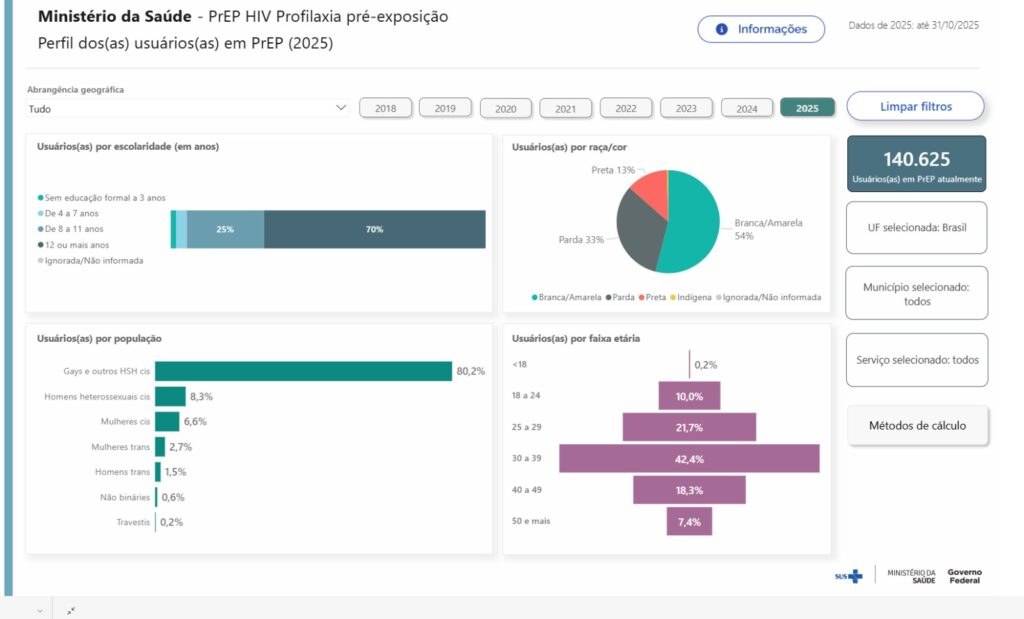
Screenshot of the PrEP Panel/Ministry of Health
These figures reveal that cisgender women still lack effective access to PrEP, whether due to lack of information, structural barriers within health services, or stigmas related to female sexuality.
To better understand these barriers, PrEP América do Sul spoke with Thais Naves, a Social Sciences professor and a cisgender woman who uses PrEP, who shared the difficulties she faced in accessing prevention in Rio Claro, in the interior of São Paulo.
📺 Assista à entrevista completa em nosso Instagram ou, se preferir, leia a transcrição completa abaixo.
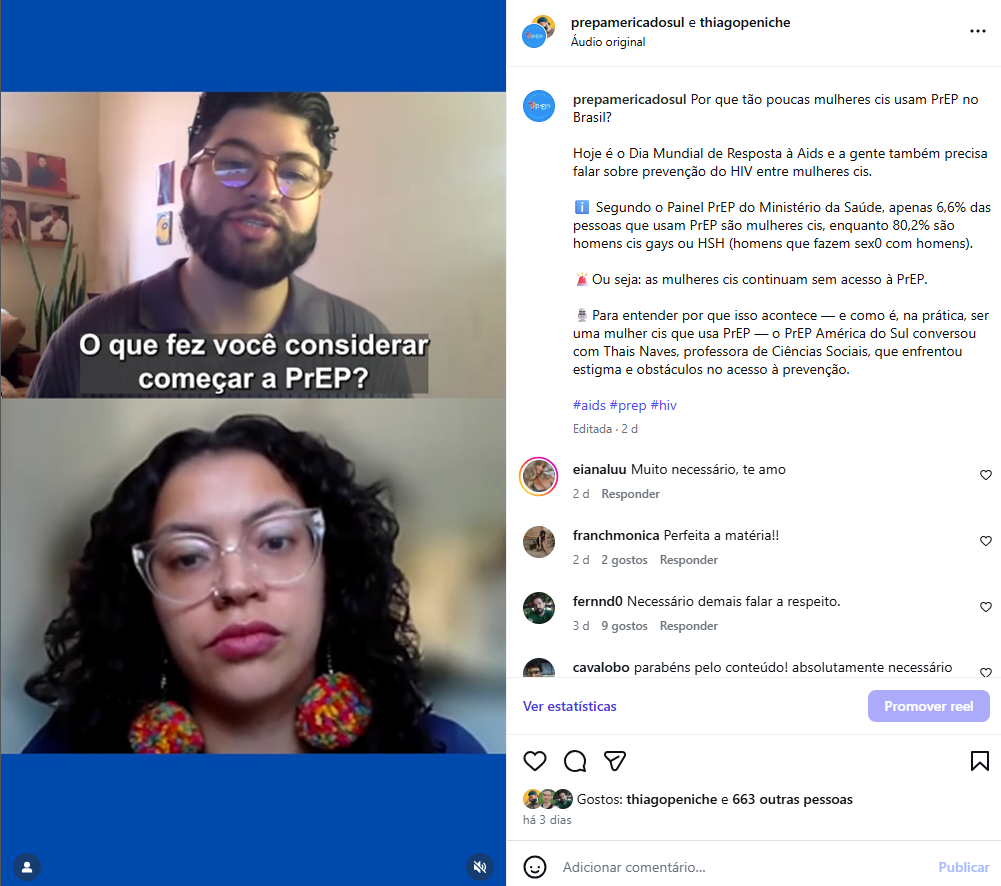
Interview with Thais Naves, conducted by Thiago Peniche (PrEP América do Sul).
Transcrição — Entrevista com Thaís Naves
Thais:
It was on social media. And, in addition to that, I always sought information because, as a teacher, I always taught these methods—both for preventing STIs and for contraception—to my high school students.
Thais:
Foi nas redes sociais. E, para além disso, eu sempre busquei informações, porque como professora, eu sempre passava esses métodos — tanto de prevenção contra ISTs quanto de contracepção — para os meus alunos do ensino médio.
PrEP América do Sul:
You, as a cis woman… it's not very common for cis women to use PrEP. What made you consider starting?
Thais:
I am a cisgender pansexual woman. So I have relationships with people who have vulvas. That was the main reason I started taking it: because for people like me, this is the only autonomous method, in addition to testing. There is no other method like it.
Furthermore, I had contact with a friend who contracted HIV, and that was a wake-up call for me that HIV transmission also happens among people like me.
PrEP América do Sul:
Do you remember being afraid of starting PrEP?
Thais:
Yes. I take other medications, so my fear was overloading my liver. But it was super easy, I didn't have any side effects, nor any overload. Quite the opposite: now, with PrEP, I monitor my health much more closely—my liver, my kidneys… I get checkups every three months, something I didn't do before. So, instead of getting worse, as I imagined, it got better. I would say it improved my overall health, not just my sexual health.
PrEP América do Sul:
Where did you start PrEP?
Thais:
Today I live in the interior of São Paulo, but I started PrEP in the capital. It was super easy: I arrived, said I wanted to take it, had the tests done, and soon after I was already on the medication. They answered all my questions.
But when I came to the countryside, I felt the stigma. I went to a specialized center and, right away, they asked if I was living with HIV. I said no, that I was only there to continue treatment. I felt I had to explain myself too much, expose myself too much. They asked me, "Oh, but don't you use condoms? But aren't you this? Aren't you that?" I felt exposed.
Another thing: when I go to get PrEP, they always look for my name on the list of people who are already living with HIV.
PrEP América do Sul:
Have you recommended PrEP to any female friends?
Thais:
Yes. For two friends. But they didn't continue because, when they arrived at Sepa (a specialized center), they faced several difficulties: demands, embarrassing questions… they also felt super exposed. One of them even had to lie, saying that she “had a lot of relationships out there” to try to get the medication approved—and even then she left without it. I think it's more difficult for cis women in the countryside. This friend, in fact, gave up on PrEP because they made access too difficult.
PrEP América do Sul:
Do you suffer any kind of stigma?
Thais:
The moments when I felt most stigmatized were within the healthcare system itself. Once, during a routine check-up, they asked what medications I was taking, and I said I was taking PrEP. The doctor asked, "Wow, but why?" and asked several other questions. In the end, she told me "not to mention that at the next exam." It was a state-mandated exam, an educational one. Even after so many years, talking about HIV and AIDS is still a huge taboo in Brazil.
PrEP América do Sul:
What do you like the most about PrEP?
Thais:
Autonomy. The autonomy of my prevention.
The role of prevention and contraception is always given to cis men.
And me, as a cis woman, taking something that prevents me… and it being just for me… I think it's incredible, revolutionary.
And also: almost no one uses internal condoms. They haven't become normalized in our society. When I talk to my friends, they say "it's ugly, it sticks out," and many report discomfort. Society hasn't incorporated internal condoms. And there's also the very common practice of cis men removing the condom during intercourse. So PrEP gives me some security—at least in relation to HIV.
PrEP América do Sul:
Do you see PrEP campaigns targeted at cisgender women?
Thais:
I don't see any. Maybe because I'm LGBT I have more access to information, but campaigns actually made for cis women... I don't see any.
PrEP América do Sul:
And how do you see the importance of PrEP for cisgender women?
Thais:
Today I see it as essential. For single and married women.
There's still this idea that prevention is "for single people," as if married people don't need it—as if fidelity, in itself, were a method of prevention. It isn't.
PrEP South America:
Is there anything else you'd like to know about PrEP?
Thais:
I just remembered another positive thing: The Ministry of Health made the HPV vaccine available last year and, this year, the hepatitis A vaccine for those using PrEP. Those using PrEP are entitled to these immunizations, so that's also very good.
PrEP América do Sul:
Do you have a final message for the cisgender women who are watching?
Thais:
Cis women, use PrEP.
Whether you are heterosexual, pansexual, bisexual — of any orientation.
It's very important to have autonomy over our prevention.
We need to be the main agents of our own care.

 English
  Portuguese
  Spanish