


Written by Thiago Peniche, Fernando Joaquim da Silva Junior e Kris H. Oliveira
On June 27, 2025, anthropologist Fernando Joaquim da Silva Junior defended his doctoral thesis at the Federal University of Rio Grande do Norte (UFRN), entitled “(In)gering a Prevention Policy: an ethnography of PrEP in the biomedicalization of the HIV response in Rio Grande do Norte, Brazil”. The research, supervised by Prof. Dr. Carlos Guilherme do Valle, regional coordinator of the PrEP South America project in the Northeast, was carried out with support from CNPq (Doctoral Scholarship and Bench Fee) and had an examining board composed of Profs. Drs. Francisco Cleiton Vieira Silva do Rêgo (UFRN), Rita de Cassia Maria Neves (UFRN), Rozeli Maria Porto (UFRN), Kris Herik de Oliveira (FMUSP), Simone Souza Monteiro (ENSP/Fiocruz). This work offers an anthropological perspective on the implementation of PrEP (pre-exposure prophylaxis for HIV) in the city of Natal (RN), based on a sensitive and committed ethnography conducted in the Quintas neighborhood – a symbolic territory in the response to the HIV/AIDS epidemic in the state. The research analyzes the interfaces between public policies, prevention practices, and everyday experiences, discussing access strategies, the local dynamics of health services, the challenges faced by users, and the layers of meaning that permeate the use (or refusal) of PrEP in real life.
Nesta entrevista para a série “Em campo” From the PrEP South America project, the anthropologist shares the methodological approaches of the research, the findings that emerged from the fieldwork, and the implications that his investigation brings for improving public policies for HIV prevention in Brazil.
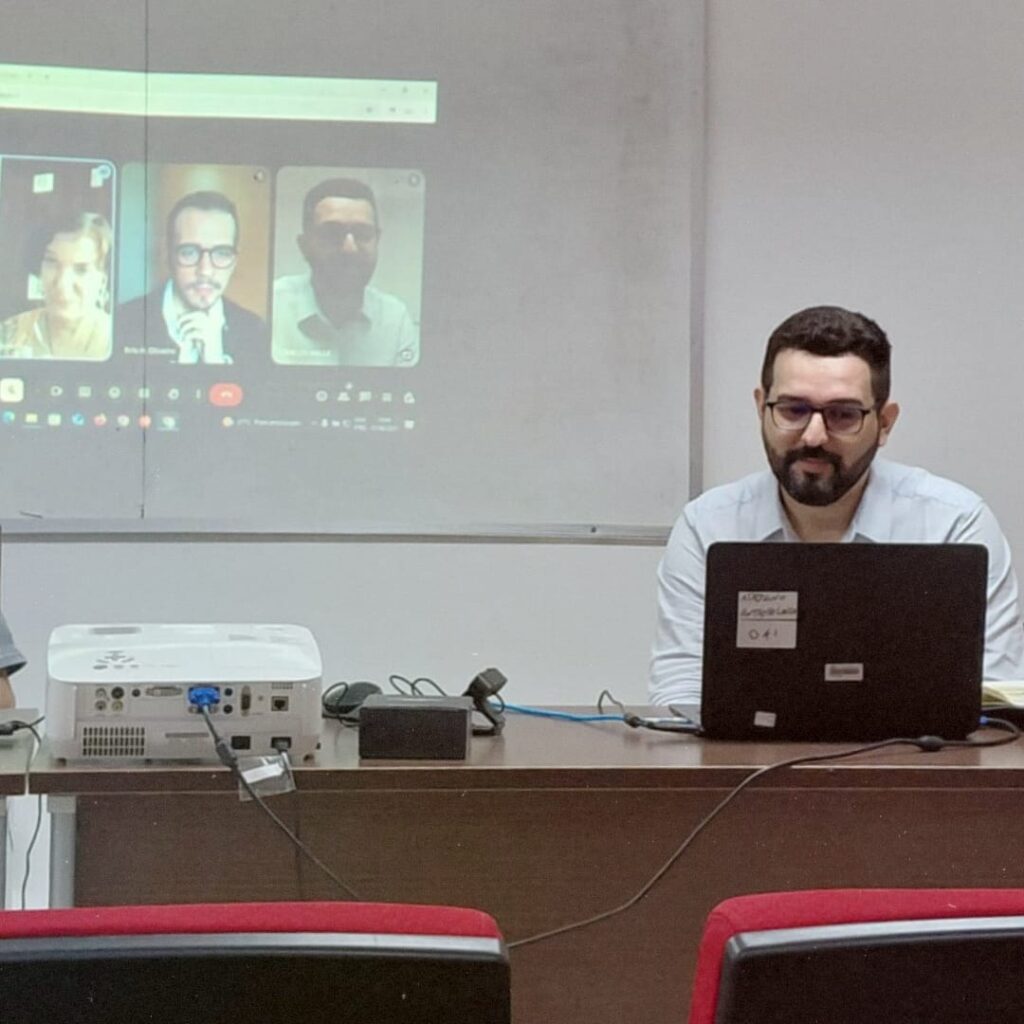
Anthropologist Fernando Joaquim during the defense of his doctoral thesis at UFRN, with the evaluation committee in the background.
INTERVIEW
Thiago Peniche – What is your thesis about?
Fernando Joaquim – In my thesis, PrEP is understood as a public policy. It is not merely a medication taken for HIV prevention. The research treats PrEP as a public policy, a prevention strategy, a pharmacological technology, and also as everyday prevention, carried out by people in their sexual and affective experiences.
I sought to understand the social debate surrounding this medication: while it is an increasingly individualized, biomedicalized, and global technology, it is also permeated by a neoliberal logic of individual responsibility.
On the other hand, PrEP is also seen as a hope. Some see it as the "end of AIDS," as has happened in the social debate surrounding Lenacapivir. So, there is a contrast: on one hand, criticism of PrEP; on the other, an almost naive hope. It is within this field of tension that my research is situated.
Thiago – Where has your research taken place?
Fernando – I'm from Natal, in Rio Grande do Norte, and I conducted this research in my own neighborhood, the Quintas neighborhood. The Giselda Trigueiro Hospital was built there, one of the first to treat AIDS cases in the state, and next to it was the Institute of Tropical Medicine, the first dispenser of PrEP in the city. The research develops within this intertwining of the past and present of the response to HIV.
Thiago – And methodologically, how was the work conducted?
Fernando – The research was based on participant observation, with interlocutors who were already part of my master's program and continued with me in my doctoral studies. I started the fieldwork in March 2020, right at the beginning of the COVID-19 pandemic. Faced with the uncertainties, I immersed myself in digital fieldwork, using "hookup" apps like Scruff and Grindr.
These apps allowed me to observe how PrEP is experienced in relationships of desire, affection, and care. They also allowed me to access a network of people involved in a public policy that is still quite fragile in the city.
Thiago – You mentioned using Grindr and Scruff as part of your methodology. Can you tell us more about that?
Fernando – At first I used Scruff, but I soon realized that Grindr had more PrEP users in Natal. I signed up for Grindr's paid plan and put "anthropologist" in my nickname. That sparked curiosity. A lot of people contacted me to talk about PrEP. Others sent nudes directly (laughs).
This research was conducted in a sensitive context, involving negotiation, listening, and confidentiality, following the principles of the Code of Ethics of the ABA, the Brazilian Anthropological Association.
Thiago – What were the main challenges you faced?
Fernando – One of the main things was the fact that the anthropologist is also observed. My body was part of the research. Some interlocutors wanted to go beyond the research relationship. I'll give you an example: a neighbor asked me for a condom on Grindr. I was unsure whether to bring it or not. I went up to his apartment—and that was all. But we are affected by these experiences.
The research also placed me in situations where I recognized interlocutors in academia, at parties, in cafes. I was immersed, spatially and symbolically, as a gay man from my city.
Thiago – Were there any particularly noteworthy cases?
Fernando – An interlocutor added me on Instagram, and only later did I realize it was from the research group. We met at church, an inclusive church. We formed a friendship, and he began to share his traumas, especially regarding his sexuality and his relationship with health services.
This research became a therapeutic space for him. Perhaps because I had some knowledge about PrEP, he felt comfortable. Today we are friends.
Thiago – Has this happened often?
Fernando – Yes. The conversations started on the apps and then moved to WhatsApp. Some arranged in-person meetings or invited me to accompany them to health services. Natal is a very small city. We usually say: "Natal has three people – me, you, and someone we know in common."
Something that emerged strongly was the bond of solidarity among PrEP users. Many brought friends—trans men, trans women, cis people—to the services. This has to do with stigma.
The Institute of Tropical Medicine is located next to the Giselda Hospital, where the first AIDS patients were treated. There is a symbolic weight to that place. People who spoke there said: "the energy there is heavy," "I feel watched." And, often, they couldn't explain why.
Upon further discussion, I realized it was the historical sedimentation of stigma. To cope with it, people stuck together—it was a form of resistance, of emotional survival.
Thiago – Could you tell us a little more about the results of your thesis?
Fernando – The thesis is divided into four chapters. The first is a historical reconstruction of the response to HIV. An ethnography informed by time.
In the second chapter, I offer a critical analysis of clinical protocols and PrEP guidelines. I discuss the "anthropology of evidence," showing how studies like FemPrEP, which indicated low adherence among cisgender women, resulted in public policies that excluded them from access.
I'm talking, for example, about the case of Marina—a Black woman, a single mother—who was systematically neglected. From 2018 to 2023, I went with her several times to try to access PrEP. We only succeeded in 2023, after much persistence.
The third chapter is an ethnography of the city, its services, and its routes. In the fourth, I analyze the apps and the public debate—including the refusals to use PrEP. Some interviewees preferred condoms; others heard that the medication was harmful to the liver. There is a lot of misinformation.
But there are also cases like Coralina's, a trans woman who sought PrEP during her transition and was denied access due to transphobia. Later, she ended up testing positive.
These cases show that adherence doesn't depend solely on individual willpower. PrEP cannot be thought of as merely individual prevention—it needs to be considered socially.
Thiago – How can your research contribute to public policies?
Fernando – Listening to people. Listening to those who take and those who do not take PrEP, because public debate happens in different ways and in different contexts. Border regions, such as the South American PrEP project shown, are very different from cities such as Natal.
For example, at the Institute of Tropical Medicine, an interlocutor reported that people who receive PrEP, PEP, and antiretrovirals wait in the same line. According to him: "Not for me, but for those living with HIV, this breaks confidentiality."
It's a right. And confidentiality isn't being guaranteed. Another person suggested using numbered cards—instead of calling patients by name in the lobby. Some people were still wearing masks and sunglasses even after the pandemic ended.
I think that's what the research is trying to show: we need to listen more. And ensure that prevention policy is, in fact, participatory.
In the final stages of his thesis, Fernando also joined the research team of fellows in the PrEP South America project. According to him, this experience broadened his bibliographic repertoire and contributed to reflections that emerged in collective debates held among the fellows—including a training course with the participation of professionals from the fields of psychology, anthropology, public health, among others.

 English
  Portuguese
  Spanish