


Memory and identity in HIV/AIDS activism in Paraíba
Written by Thiago Peniche
Interviewee: Maio Spellman
Supervision: Kris H. Oliveira
In over three decades of confronting HIV/AIDS, the social movement in Brazil has accumulated stories, achievements, and profound marks on public health and human rights. In Paraíba, this trajectory is made up of struggles for access to diagnosis, guaranteed treatment, and responses to stigma—battles that, in part, remain alive to this day.
In this interview for the series “In the Field,” we spoke with Maio Spellman Quirino de Farias, a psychologist with a PhD in Anthropology from the Federal University of Paraíba (UFPB) and a Technological and Industrial Development Fellow (DTI), who dedicated his thesis to investigating memory, activism, and identity within the HIV/AIDS social movement in the state. With experience beginning in 1994 at the Life Support Group (GAV), Maio revisits the past, analyzes the transformations in agendas and strategies, and reflects on how history shapes the present—including the arrival of PrEP as part of combined prevention.

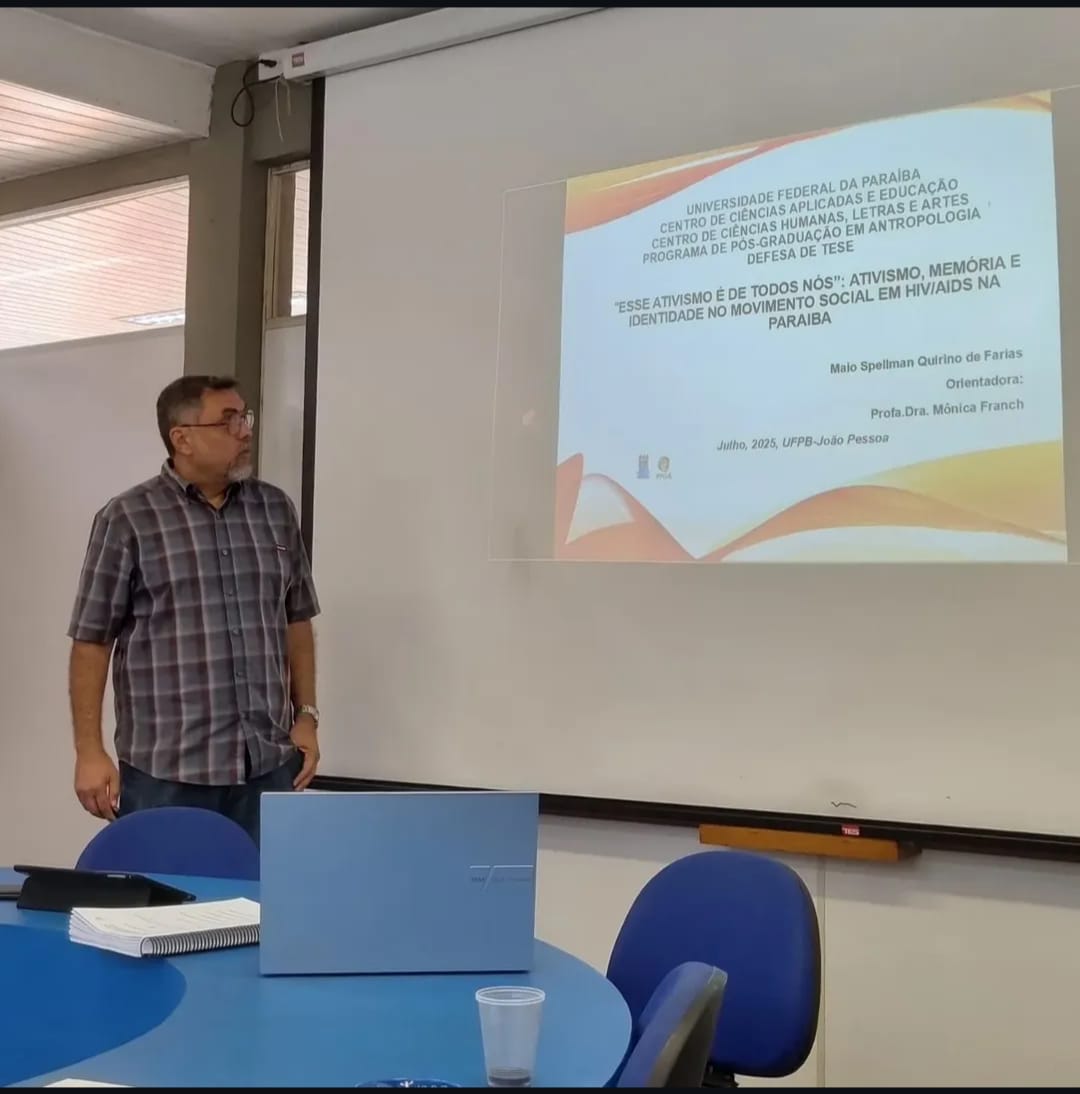
Psychologist and PhD in Social Anthropology Maio Spellman, alongside his advisor Prof. Dr. Mônica Franch, during the defense of his doctoral thesis at UFPB.
Thiago: Maio, to start, can you tell us about the topic of your doctoral thesis?
Maio: My thesis was about HIV/AIDS activism in Paraíba and is titled: “This activism belongs to all of us: activism, memory and identity of the social movement in HIV/AIDS in Paraíba.” I researched four institutions—three in João Pessoa (Association of Prostitutes of Paraíba – APROS-PB, Cordel Vida, and Maria Quitéria Women's Group) and one in Campina Grande (Life Support Group – GAV), where I began my journey in activism in 1994, as well as former activists, managers, and former managers of HIV/AIDS health services, totaling 11 interlocutors. It was a qualitative research, with semi-structured questionnaires and ethnographic inspiration.
Thiago: How did your journey within the movement help shape this research?
Maio: My history with the movement began at GAV in Campina Grande when I was still an undergraduate in Psychology. I actively participated for 10 years. Later, I did my master's degree at UFRN, also studying GAV, and returned to the topic in my doctorate in 2020, in the Postgraduate Program in Anthropology at UFPB. Returning to the field after 15 years was a shock: some historical issues have advanced, such as access to diagnosis and treatment, the emergence of PrEP, but others still remain, such as the fight against stigma.
Thiago: In your research, how did you characterize the activist subject?
Maio: Today's activist still largely resembles the profile of the past: they generally arrive through their own serological experience, through grief—the loss of a friend or family member—or as an arm of academia, based on research and studies. These are personal stories that transform into collective causes.
Thiago: What were the main agendas and strategies of the movement in the 1990s and 2000s?
Maio: At that time, the priority was to guarantee diagnosis, universal access to hospital beds, and treatment. Prevention was centered on the use of condoms, and actions were very hands-on: distribution of informational material at events, public demonstrations, meetings with health departments to define annual goals. There was also press relations and media monitoring to track how the media portrayed AIDS. These strategies helped build the collective identity of the movement and strengthen alliances.
Thiago: And how have these agendas and strategies changed over time?
Maio: Today, many actions have migrated to social media, and combined prevention—which includes PrEP—has become part of the discussions. But stigma remains, even within health services. Digital communication has gained strength, but the objective remains the same: to guarantee rights and confront prejudice.
Thiago: What is the importance of PrEP in the current context and in your trajectory?
Maio: PrEP is a fundamental achievement, the result of decades of struggle. It didn't exist in the 1990s and today it's an essential tool within combined prevention. However, it's still surrounded by stigma and misinformation, as if it were only intended for certain groups. I've heard accounts from people I speak with, including within health services, saying that "PrEP is for people who have a lot of sex"—a moral judgment that excludes those who could benefit from it. Our challenge today is to disseminate information and guarantee universal access.
Thiago: Did the PrEP South America Project play any role in updating your knowledge on the subject?
Maio: For sure. After 15 years away from direct activism, the project helped me update my knowledge and better understand the current reality. I took courses, read about oral and on-demand PrEP, and started participating in discussions with other researchers and activists. This made me realize that even using PrEP can be an act of activism, especially when fighting to expand access to it.
Thiago: Which testimonies stood out to you during your research and help you understand the stigma surrounding HIV?
Maio: One case involved ride-hailing drivers who refused to take passengers to the Clementino Fraga hospital, a leading HIV/AIDS center. This reveals how the stigma from 30 years ago still persists. I was also struck by the account of someone who, when seeking care, heard from a staff member: “Are you so-and-so? I know your family.” This type of exposure is embarrassing and violates privacy, reinforcing barriers to access.
Thiago: Thiago: In your thesis you also talked about the media. Can you share examples of how the press portrayed HIV/AIDS in the 80s and 90s?
Maio: In the beginning, the coverage was sensationalist and biased. Headlines like "AIDS emerges in São Paulo" and headlines such as "HIV kills 6" created moral panic. Some newspapers treated "HIV" as if it could even be a person's initials—it was the logic of scandal, not information. The deaths of famous people, such as Cazuza and Freddie Mercury, were also treated in an exploitative way, reinforcing stereotypes and fear. In Paraíba, I remember the 1985 headline about the first confirmed case in the state, in the Correio da Paraíba newspaper. Expressions like "AIDS patient" were common and helped to socially isolate those living with the virus: "social death" came before biological death. Over time, the organization of the movement and changes in society pushed for a different narrative.
Thiago: Thiago: What is the role of activism in expanding access to PrEP and combating stigma?
Maio: It's crucial. The activist movement has changed because the agendas have also changed. Thirty years ago, NGOs dealt specifically with "AIDS," and even organizations outside the AIDS field maintained a focus on the topic. Today, access to PrEP is an issue extremely monitored by the social movement in Paraíba—and I believe in other places as well.
Using PrEP is becoming essential, but there's a prior issue: there's still a lack of information. It's as if PrEP is in a "bubble," which generates stigma and prejudice, as if it were intended only for a specific group of the Brazilian population. Therefore, the social movement questions this perception and seeks to disseminate information, working collectively to expand knowledge.
Here in João Pessoa, PrEP is distributed at some referral services. But, for example, someone who lives far away and needs to travel to one of these locations might end up giving up. One of our interlocutors commented: "PrEP is not treatment." Meanwhile, people from APROS (Association of Women in Health) said that many women prefer to continue using condoms because they think PrEP is like a treatment for those already living with HIV. These perceptions are circulating, and the social movement is attentive to them, challenging the services, demanding changes, and offering its contribution. Today, concern about PrEP is undoubtedly an activist issue.
Thiago: What do you mean by "this activism belongs to all of us"? Can you explain?
Maio: During my research and throughout my journey in the movement, some people have asked me: “You don’t live with HIV, you’re not a gay man… why are you in the movement?” This is a question that goes back to the very history of activism. In the 1990s, when I joined GAV, the motto was solidarity. It was a collective commitment, not just for those living with the virus. A colleague, Valdomiro, said something that stuck with me: “This activism belongs to all of us—and now is when it really needs to.” This phrase translates the idea that the fight against HIV/AIDS belongs to all of society because it involves human rights, responding to prejudice, and universal access to healthcare.

 English
  Portuguese
  Spanish